

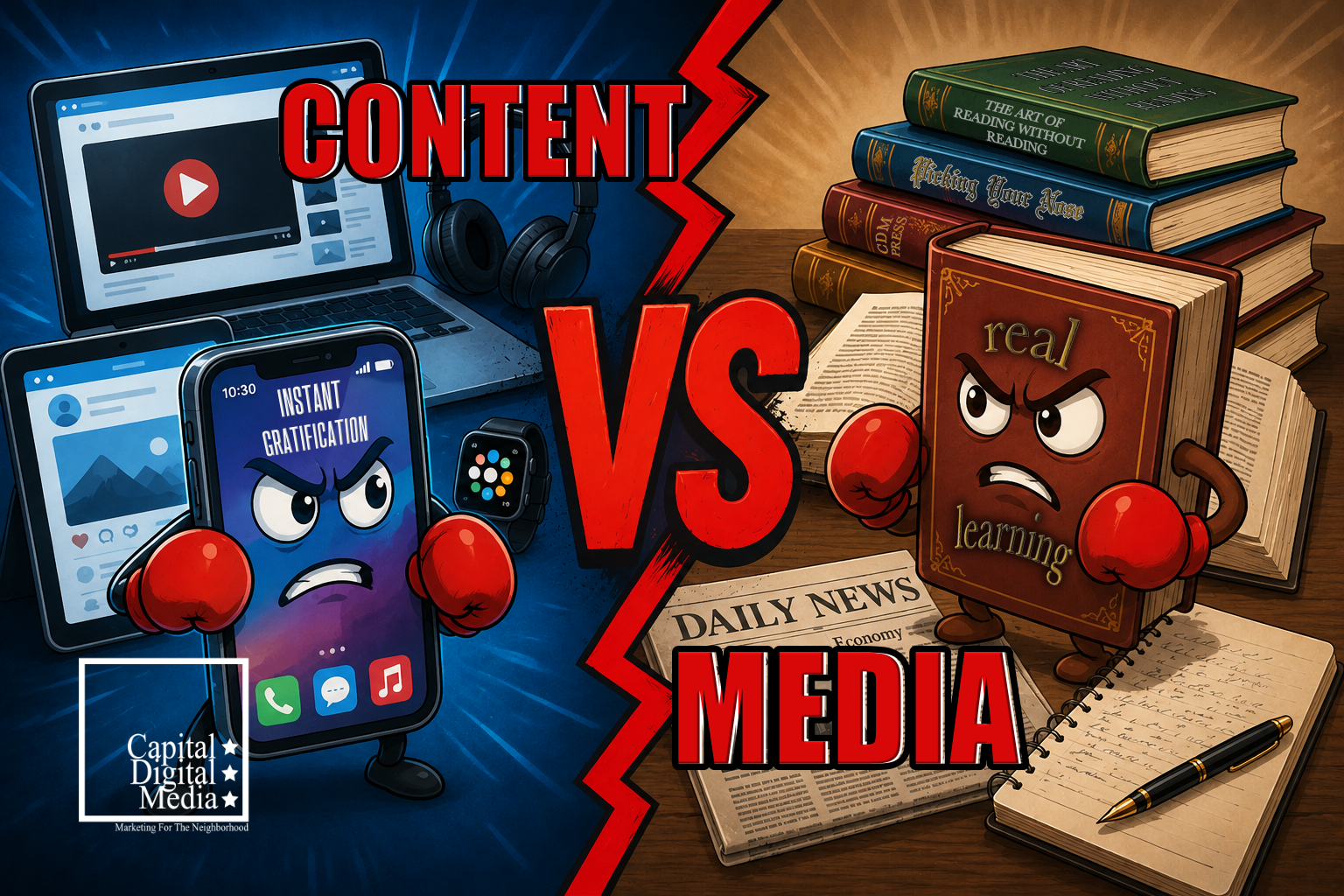
Content VS Media
From Media to Content: How a Single Word Changed Our Relationship with Information
For most of modern history, we distinguished communication by what it was trying to achieve. Journalists reported news, filmmakers made movies, authors wrote books, musicians composed music. Each medium carried its own standards, expectations, and responsibilities.
Today, however, an increasing amount of our culture is described with a single word:
Content.
At first glance, this appears to be harmless shorthand. But the shift from media to content represents something much larger than a change in vocabulary. It reflects a fundamental change in how this growing digital society values and assimilates communication and information. As physical media sources get fazed out for the digital, challenges arise in identifying reputable sources, credibility and intention.
“Not All Content Is Media, But All Media Is Content.”
Media Implies Purpose
Historically, “media” referred to the mediums through which ideas moved between people.
Newspapers existed to inform.
Documentaries sought to investigate.
Books preserved knowledge or told stories.
Television entertained, educated, or reported.
Even when imperfect or biased, these forms generally operated within recognizable frameworks. Journalism developed editorial standards. Scientific publishing required peer review. Documentary filmmaking emphasized sourcing and evidence. Institutions were expected to justify their credibility through transparent methods.
The medium mattered because its purpose mattered.
Content Is Format Without Hierarchy
Digital platforms introduced a different logic.
To an algorithm, every upload is fundamentally the same.
A thirty-second dance clip.
A scientific lecture.
An investigative exposé.
A cooking tutorial.
A conspiracy theory.
A family vacation montage.
Each becomes a piece of content competing for the same finite resource: human attention.
The platform does not first ask whether something is true, meaningful, artistic, or historically important. It asks whether people will click, watch, comment, and return.
The word “content” reflects this flattening.
Everything becomes an interchangeable asset moving through a recommendation engine.
The Rise Of The Content Creator
Lets examine how “content creator” emerged as a profession. Unlike a journalist, filmmaker, educator, or photographer, the title does not specify a craft.
It specifies participation in an attention economy.
The creator’s product is not necessarily journalism, cinema, education, or art.
The product is consistent engagement.
Some creators absolutely produce journalism.
Others produce excellent educational work.
Many produce remarkable art.
 But the title itself says nothing about methodology, evidence, or editorial practice. It describes a relationship with distribution rather than a relationship with knowledge.
Why Some Professionals Resist the Label
 Many experienced journalists and filmmakers dislike being called content creators. Not because the work is beneath them. But because the word dissolves distinctions they spent decades building.
A Pulitzer-winning investigation and a reaction video become “content.”
A peer-reviewed explanation of climate science and an unsupported opinion become “content.”
An award-winning documentary and a viral prank become “content.”
The label treats them as equivalent inputs into the same system.
From the platform’s perspective, they often are. From society’s perspective, they should not be.
Legitimacy Without Institutions
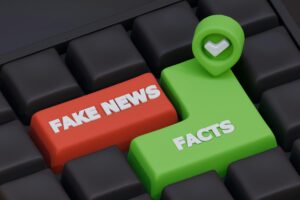 This is not an argument for returning to a world where only institutions speak. Traditional media has made serious mistakes and institutions have failed, shown bias, and lost public trust. Meanwhile, independent creators have broken important stories, educated millions, and produced work that rivals or surpasses established organizations. The difference is not institutional versus independent.
It is methodological.
Credibility should be earned through transparent evidence, clear sourcing, reproducible claims, editorial accountability, and intellectual honesty—whether the work comes from a newsroom, a university, or a YouTube channel.
Media, Content, And The Future
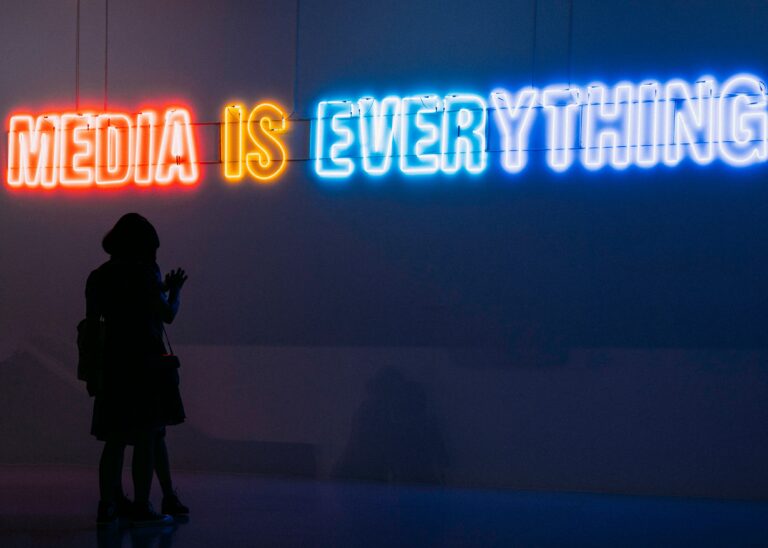
Perhaps the most important distinction between Content VS Media, is this:
Media describes a form of communication, WHILE Content describes a unit of distribution.
These are not the same thing.
Media asks what a work is trying to accomplish, WHILE Content asks how efficiently it moves through a platform.
 As algorithms become the primary gatekeepers of public attention, society risks adopting the platform’s vocabulary as its own. If everything becomes content, then every idea begins to compete under the same metric: engagement. The challenge for the next generation is not to reject creators or romanticize legacy media.
It is to recover distinctions that matter.
Some work exists to entertain.
Some exists to persuade.
Some exists to document reality.
Some exists to preserve knowledge.
These differences are not obsolete simply because they now appear in the same social media feed.  Words shape categories AND categories shape values. Perhaps the most consequential shift of the digital age was not replacing newspapers with smartphones.
It was replacing media with content—and quietly accepting that all communication could be measured by the same standard.


